2026
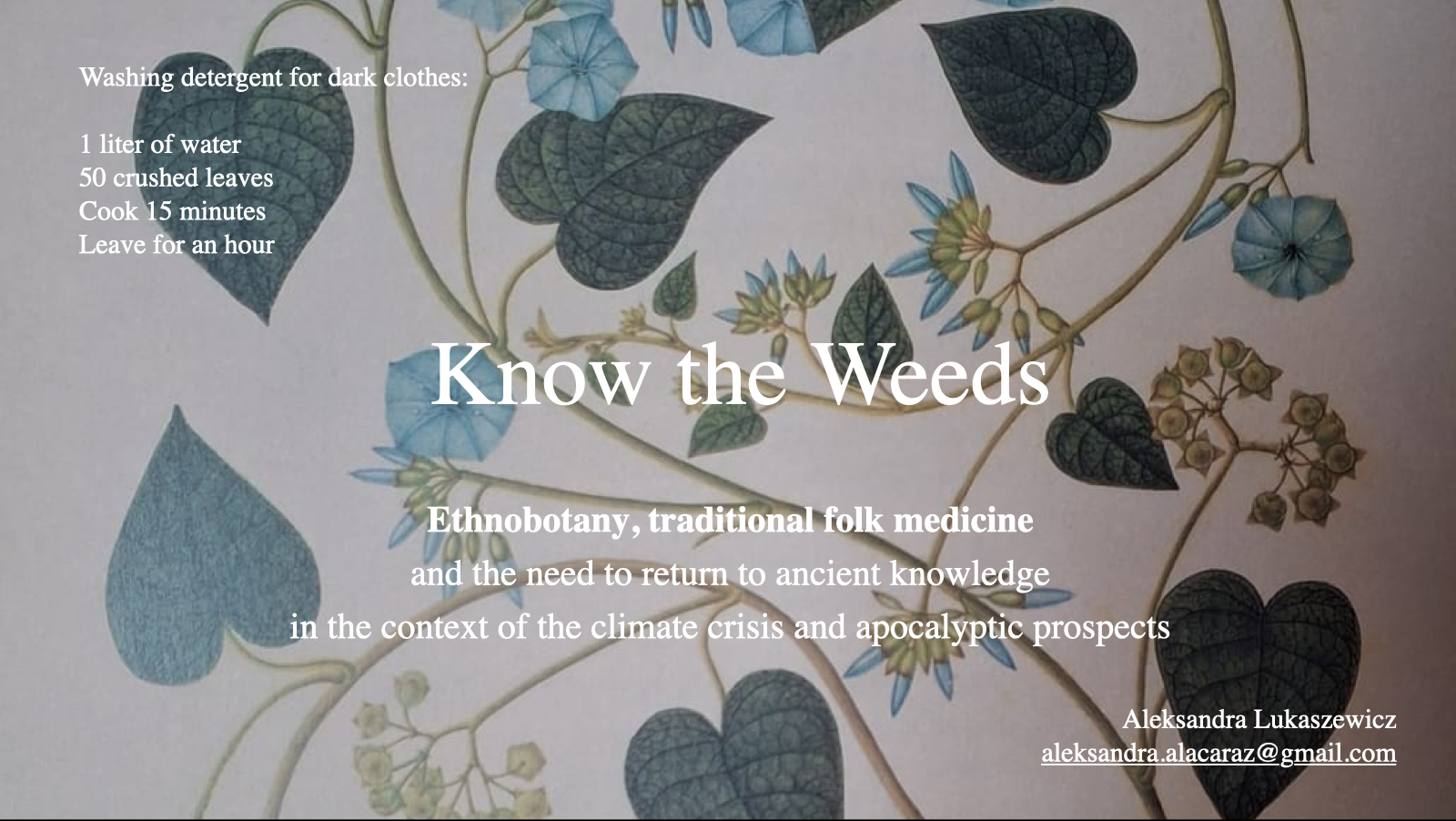
The Importance of Indigenous Knowledges in Times of Climate Crisis
Aleksandra Łukaszewicz
The Anthropocene has placed humanity in a precarious position, defined by
accelerating climate change, resource depletion, and a gradual loss of the skills
that long enabled human survival. In many regions of the Global North, daily life
depends on extensive infrastructures of energy, industrial agriculture, modern
medicine, and mass production. Skills such as growing food, identifying edible
plants, preparing nourishment, healing injuries, building shelter, or producing
clothing have not only undergone cultural transformation but have also been largely
delegated to specialists and machine systems. This condition may seem like the
culmination of progress, yet it obscures the vulnerability created by our dependence
on fragile and resource-intensive networks.
If these networks falter, survival will hinge on the ability to adapt. Historically,
crises have led either to violent competition for resources or to the cultivation of
new forms of cooperation and resilience. Adaptation is not only biological but also
cultural, shaped by ways of knowing and relating. Traditions that emphasize
coexistence, interdependence, and reciprocal engagement with the environment can be
found across many cultures, particularly among Indigenous communities. These cultures
are grounded in ecological knowledge systems that situate humans as participants
within living environments rather than as their masters.
This perspective suggests two imperatives. First, following United Nations
recommendations, Indigenous knowledge must be actively preserved. Second, rather than
attempting to reproduce Indigenous lifeways, we should adopt their relational
approach to the environment, fostering new ecological balances. Sustaining epistemic
diversity is therefore not only an ethical task but a practical one for navigating an
uncertain climatic future.
Keywords: Indigenous Knowledge, Epistemic System, Climate Crisis, Adaptation.
Pobierz PDF
2024
Body as a place of resistance to pandemic politics of global corporations. Recovering sensibility of the body
Aleksandra Łukaszewicz
In: Somapower: Somaesthetics Reads Politics, Leszek Koczanowicz (ed.),
Boston, Massachusetts: BRILL, 2024.
Capillary practices of power are disseminating in contemporary form of the society
of control, about which wrote Deleuze in Postscript on the Societies of
Control developing and adjusting to nowadays Foucauldian analysis of power
relations in disciplinary society. Practices of power reach individual bodies, which
are controlled in their movements and worldly actions by digital technologies –
traced, monitored, and formed according to the images promoted. The contemporary
form of power is digitally embracing each and one of us in the unprecedented ever way
touching intimate and private spheres – and again, as in 1970s as feminist postulated
“the private is political”, or even more: private sphere became public. Then, the
contemporary forms of power are executed directly on the body and through the body in
form of disciplinary power and of biopower in Foucauldian terms. However, the body is
then also the ultimate place of resistance of these practices of power. This
situation is recognized by Leszek Koczanowicz and conceptualized as somapower build
in relation to Foucault’s biopower, but also to Richard Shusterman’s somaesthetics.
The case study I want to examine here refers to power executed on bodies by global
corporations and to somapower that can be emancipating from corporation’s practices
of power. Then, I take on board the outbreak of the Covid-19 that allowed global
corporations to reach out to potentially all the bodies in the world, by means of
pharmaceutics corporations in cooperation with the World Health Organization
imposing on countries the necessity of vaccinations. The critical response to such
situation that can be understood in terms of somapower is for example the revival of
interest in traditional healing, knowledge in herbs and traditional activities (for
example infusions and syrups from Plantago lanceolata are used as
anti-virus protection). These activities sit firmly in bodies, which are active and
integral part of persons, and are a form of resistance to contemporary biopower by
developing bodily sensibility, what is the practical postulate of Richard
Shusterman somaesthetics. Arnold Berleant stresses it also advocating for recovering
of the sensibility from the capitalist abuse. For him the sensibility should be
recovered from overtake by images, smells, tastes, and sounds done by corporations
making profit from abuse of senses. From such perspective, the decision to listen to
the body, to strengthen it with natural methods, also calming the mind, to develop
its abilities and sensibility, not allowing the total corporations’ control over it,
is a political decision.
Keywords: practices of power, biopower, biopolitics, somaesthetics, sensible
engagement, resistance.
Pobierz PDF